Written by Priya Chandrasekar, Director – Rural Solutions and Finance, Udhyam Vyapaar
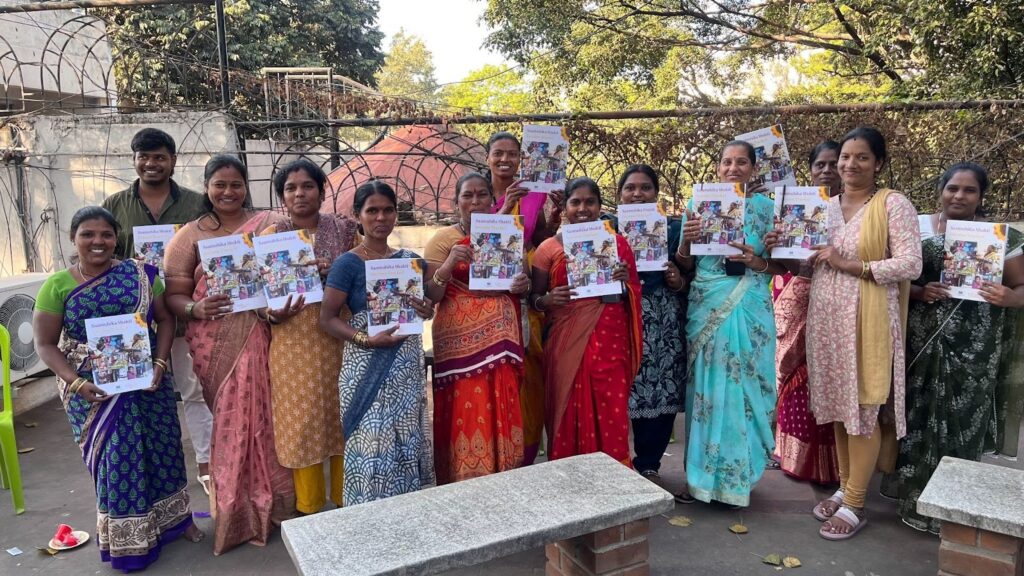
We are proud to announce the launch of our Income Tracker Booklet… What started as a challenge on the ground followed by a simple experiment with hand holding and rigorous follow up that resulted in a small but useful habit building. We are happy to share the journey below .
When working with nano-entrepreneurs and participants in the informal livelihood sector, the lack of credible financial data remains one of the most persistent challenges. Limited financial records, weak accounting practices, and the predominance of cash-based transactions result in income being largely self-reported. This not only restricts access to formal credit but also introduces significant bias. Self-reported income often reflects recency bias, with respondents citing their most recent earnings as a proxy for average income. In addition, revenue is frequently reported as income, while self-consumption is rarely accounted for. Given that income uplift for entrepreneurs is a key objective of our projects, we are continuously exploring ways to address and overcome these measurement challenges.
This was also a challenge with our nano entrepreneurs in the Saamuhika Shakti project. Saamuhika Shakti is a collective initiative in Bengaluru that brings together organisations with different but complementary strengths to support informal waste pickers and their families.
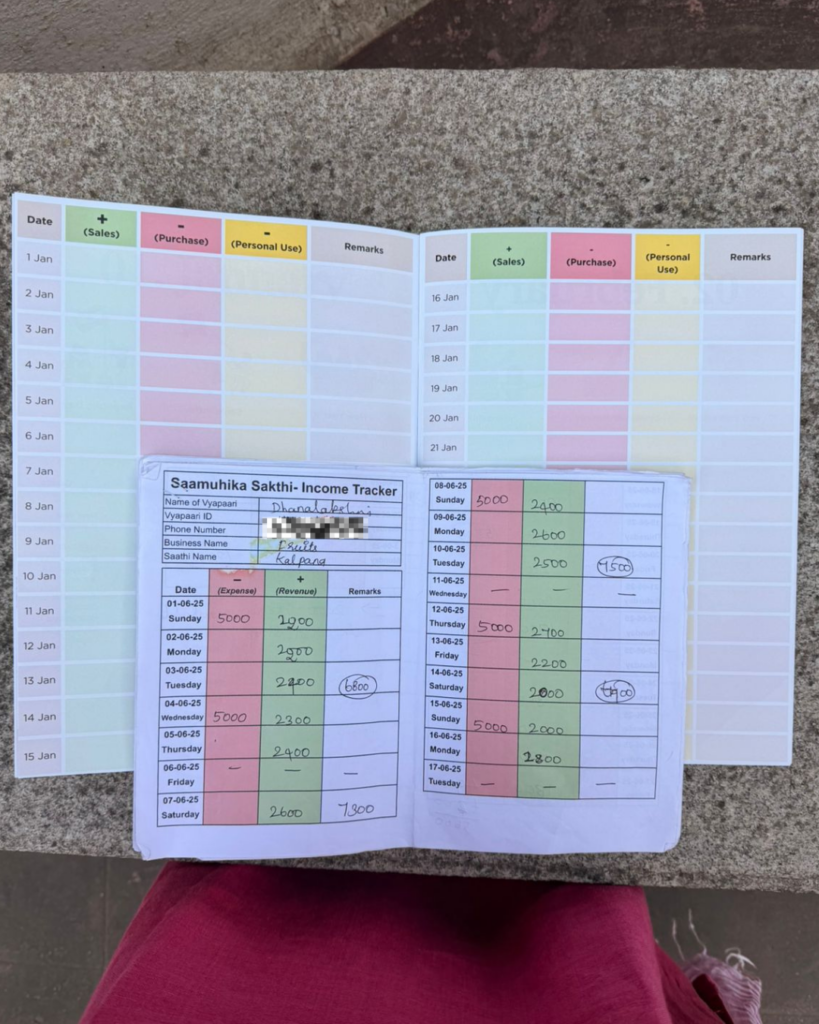
Building on early trials conducted a few years ago at Udhyam Vyapaar, we wanted to design a way for the entrepreneurs to track their sales and expenses on a daily basis. Of course, we wanted to collect more data – quantity sold, stock remaining, debt repaid etc… but then we realised that this may be too complicated a starting point for this. So we introduced a simple, date-wise two-column tracker – one to record what comes in (earnings) and the other what goes out (expenses). Earnings were colour-coded green and expenses red to make the distinction intuitive and easy to follow.
Finding the first few volunteers itself was a challenge. We began with a small pilot of four entrepreneurs, and the early days required significant hand-holding from our field staff. The Women nano-entrepreneurs were encouraged to update the tracker daily.
Over time, however, adoption improved. Habit building and the utility has led to nearly 40% of entrepreneurs in the cohort maintain the tracker independently, while another 20% do so with support from family members. Many women have shared that the tracker has helped them gain a clearer picture of their business operations.
User feedback also shaped improvements to the tool – an additional column was introduced to capture self-consumption, and a few entrepreneurs have begun pinning bills directly to the tracker. For others, our team continues to work closely to help build this practice into a regular habit.
Today, the tracking sheet exists as a single loose piece of paper and is therefore prone to damage or loss. To encourage and sustain this good practice, we have now printed the income tracking sheet as an annual booklet. We hope this not only makes it easier for women to maintain the habit, but also gradually serves as a simple financial record of their businesses over the years.
This journey also reiterated two key facts for us- that complex problems can have a simple solution and that habit building is a non-negotiable building block for sustaining good practice.