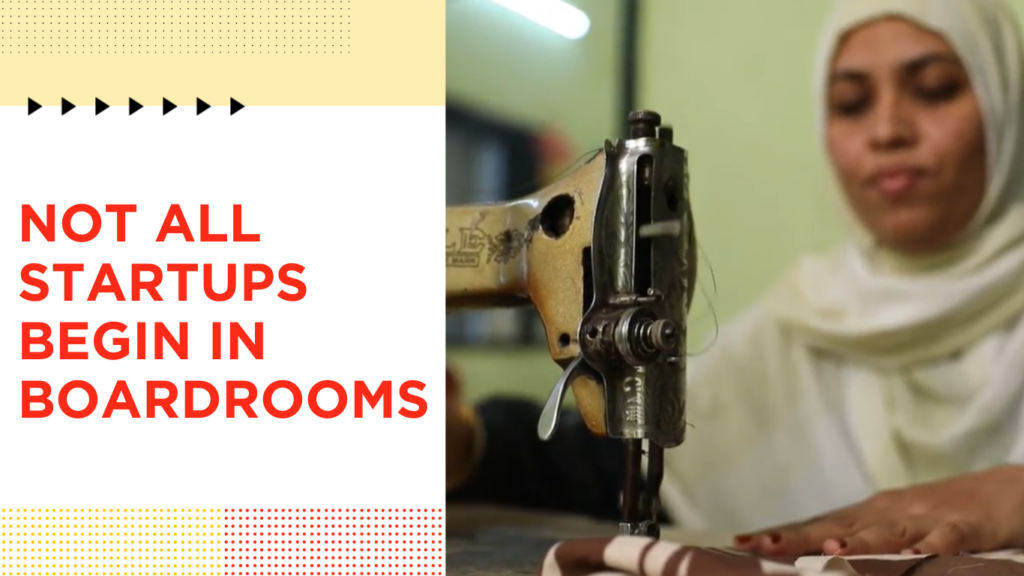
Across villages and small towns, thousands of women sit behind sewing machines every day, skilled, precise, and determined. Yet in the face of a rapidly expanding readymade market, tailoring remains invisible labour. Stitching for family and neighbours brings in only minimal income, rarely enough to grow or sustain a livelihood. The challenge was never a lack of effort or talent, but the absence of systems that could transform individual skill into access to stable markets and dignified enterprise.
Key Challenges for the Tailoring Community
Prior to the intervention, women tailors’ work was mostly limited to family, neighbours, and a small circle of local customers, with orders remaining individual and irregular. In many villages, tailoring was an overcrowded occupation, almost every household had at least one tailor, resulting in fragmented demand and intense local competition that kept earnings low.
Skill levels also varied widely. While some women possessed strong technical abilities, others relied on basic stitching skills, leading to inconsistencies in quality and limiting the ability to take on higher-value or bulk orders.
Materials were sourced in small quantities from nearby shops, leading to variable costs and inconsistent quality that directly affected earnings. The work centred on basic stitching, shaped by local demand rather than opportunities for design innovation or diversification. With no branding or marketing beyond word-of-mouth, visibility remained low even within neighbouring markets.
Working individually, and often within constrained time windows, made it difficult to take on time-bound or bulk orders. As a result, tailoring remained small-scale, informal, and vulnerable, offering little scope for growth.
The Solution: A Cluster-Led Model
Rather than treating tailors as beneficiaries lacking capacity, the intervention began by recognising their existing skills as core economic assets. Vyapaaris were organised into local clusters, transforming individual home-based activities into collaborative enterprise units. This shift enabled collective sourcing, shared production planning, and coordinated market engagement, laying the foundation for scale, efficiency, and growth.
Building Stronger Market Linkages
Cluster formation unlocked access to markets that were previously out of reach. Collectives were connected to wholesalers, bulk buyers, and local retail cloth shops dealing in high-demand products such as petticoats, blouses, nightwear, and burqas. By aggregating demand and supply, clusters could meet buyer expectations on volume, quality, and delivery timelines—something individual tailors struggled to achieve alone. There was also sustained handholding to help Vyapaaris work to a clear production plan, build awareness around quality and finishing standards, implement basic quality checks (QC), and deliver orders on time.
At the same time, clusters were encouraged to develop products with local identity and market relevance. Garments such as Mahakal kurtas, featuring designs inspired by the cultural symbolism of Mahakal, Ujjain, and Bagh-printed kurtis and bags—created using traditional hand block-printing from Bagh in Madhya Pradesh—blended cultural distinctiveness with commercial appeal. This allowed Vyapaaris to tap into niche and value-driven markets.
Strengthening Supply Chains and Production Systems
The cluster model also addressed one of the most persistent constraints – access to quality inputs. Collective sourcing enabled tailors to procure fabrics at better prices and consistent quality, reducing input costs and improving margins.
To manage fluctuations in demand, clusters were linked to suppliers of ready-made garments available at manufacturing cost. This allowed Vyapaaris to fulfil bulk orders even when in-house capacity was stretched, ensuring timely delivery and protecting buyer trust. Internal quality-check mechanisms and skill mapping across product categories further improved efficiency and consistency.
Enhancing Skills and Quality
Market access alone was not sufficient. To ensure sustainability, the intervention deliberately moved beyond standardised capacity-building approaches. Rather than starting with generic training, market linkages were established first, allowing real demand to shape the intervention.
Based on buyer requirements and production gaps identified through these market connects, need-based, targeted training was provided to selected tailors. This included optimal cutting and stitching techniques, product finishing, and value addition through embroidery and detailing. These focused improvements translated directly into higher-quality outputs and better price realisation.
Cross selling and Product Diversification
As systems stabilised, Vyapaaris began diversifying beyond basic stitching to expand their product offerings. Many tailors introduced cross-selling of complementary ready-made products such as sarees alongside their core services. This diversification enabled them to offer a broader, more convenient product mix to customers, increase average order values, and deepen customer relationships while reducing dependence on a single income stream.
Challenges Ahead and Way Forward
As tailoring enterprises scale, new challenges are emerging that will shape their long-term sustainability. One key challenge lies in aligning Vyapaari income expectations with what the market is willing to pay, particularly for job-work models, where piece rates are often perceived as insufficient despite steady volumes.
Another tension is around pricing and margins when clusters move beyond job work to purchasing fabric and stitching finished garments. While this model offers greater scope for value addition and higher margins, it also requires sharper costing, pricing discipline, and the ability to remain competitive in price-sensitive markets.
Additionally, achieving consistent, market-ready finishing increasingly demands access to higher-end machines. Without upgrades in equipment, it becomes difficult to match the quality standards expected by buyers, especially as orders scale in size and complexity.
Addressing these challenges will require strengthening cluster-level leadership, formalising operational and costing processes, investing in appropriate machinery, and deepening digital and financial capabilities. With these systems in place, tailoring can continue its transition from a survival activity to a resilient enterprise model – rooted in collective strength, efficient supply chains, and continuous innovation.