In livelihoods work, support often begins with sharing skills, tools, and frameworks to help entrepreneurs grow.
At Udhyam Vyapaar, when we stepped into the daily realities of nano-entrepreneurs, a different picture emerged. We found that often, the challenge is not just about knowing what to do, but having the means to act on that knowledge in their day-to-day business, whether it is increasing capacity, improving efficiency, or being able to serve more customers.
This is where we began to see the need for an additional kind of support that goes beyond guidance and fits into the everyday realities of running a business.
When Knowledge Isn’t Enough
For many nano-entrepreneurs, especially those operating in informal settings, businesses are not run in controlled environments.
A typical day is shaped by variables that are hard to predict:
- Fluctuating demand
- Limited working capital
- Household responsibilities
- Health or environmental disruptions
An entrepreneur may understand the importance of tracking income, but not have a simple way to do it daily. They may recognise the value of improving customer experience, but lack the resources to act on it. The gap, then, is not in awareness but rather, it is in enablement.
Shifting from Training to Tangible Support
What begins to make a difference is when support moves from being instructional to tangible. This is where asset-based solutioning becomes critical. Instead of only building knowledge, we focus on providing practical tools and assets that entrepreneurs can integrate directly into their businesses:
- A business handbook that simplifies decision-making
- An income tracker that makes financial visibility possible
- Equipment or infrastructure that improves efficiency
- Small upgrades that enhance customer experience
These are not large-scale interventions. But they are deeply aligned to how businesses function on the ground.
For instance, when the Udhyam team started working with Jeeva they identified practical gaps like not having the vessels to cook in larger quantities. We provided her with larger cooking equipment and with that additional equipment, her capacity increased. We also helped her secure her FSSAI license, improve hygiene and presentation of her stall, and with a small monetary support from Udhyam, she set up a simple canopy and seating to make her stall weather-proof and welcoming.
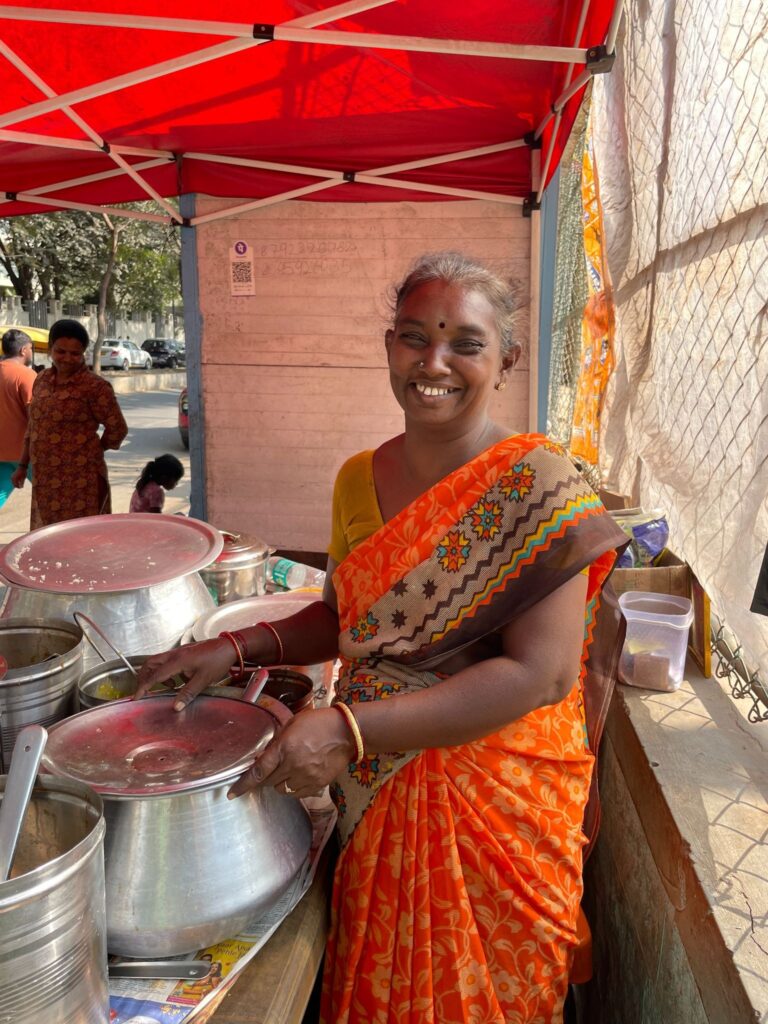
Jeeva, a food street vendor, at her stall |
PC: Udhyam Vyapaar Team
Why Assets Matter
Assets do something that training alone cannot.
They stay. It becomes part of the entrepreneur’s daily routine:
- Recording income at the end of the day
- Referring to a handbook before making a decision
- Using upgraded equipment to serve more customers
The entrepreneur is no longer dependent on external input to act – they have something in hand that supports them, every day.
This is visible in entrepreneurs like Sathya. Always looking for ways to grow, she introduced chicken kebabs to her shop’s offerings, initially cooking on firewood. But with the Udhyam team’s financial support, she transitioned to a stove, improving safety and efficiency. The team also helped fix her old dosa batter machine, allowing her to produce and sell nearly six kilograms of batter each week. She also invested in a second-hand fridge with partial support from Udhyam, to store the dosa batter and ingredients for her shop.
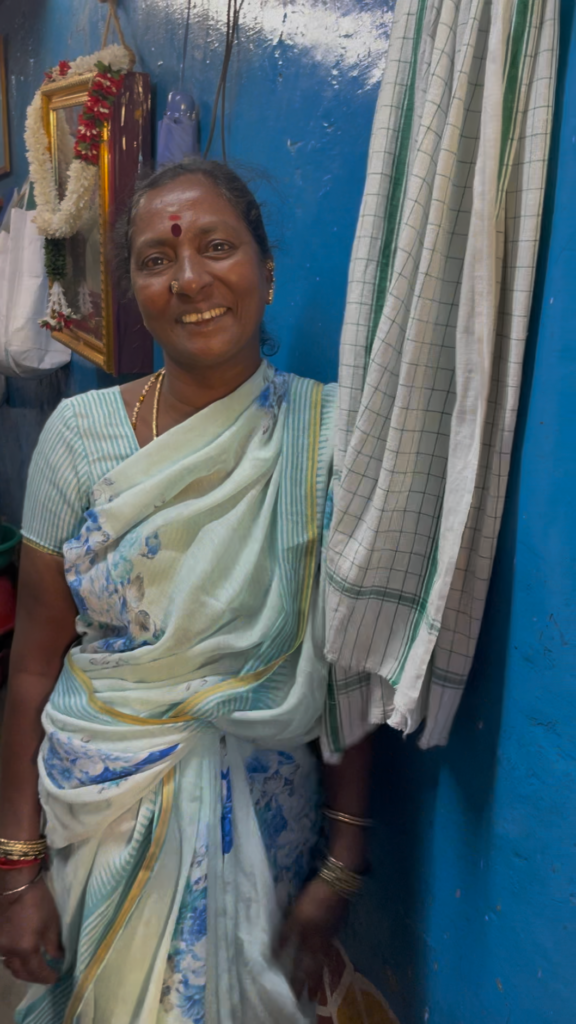
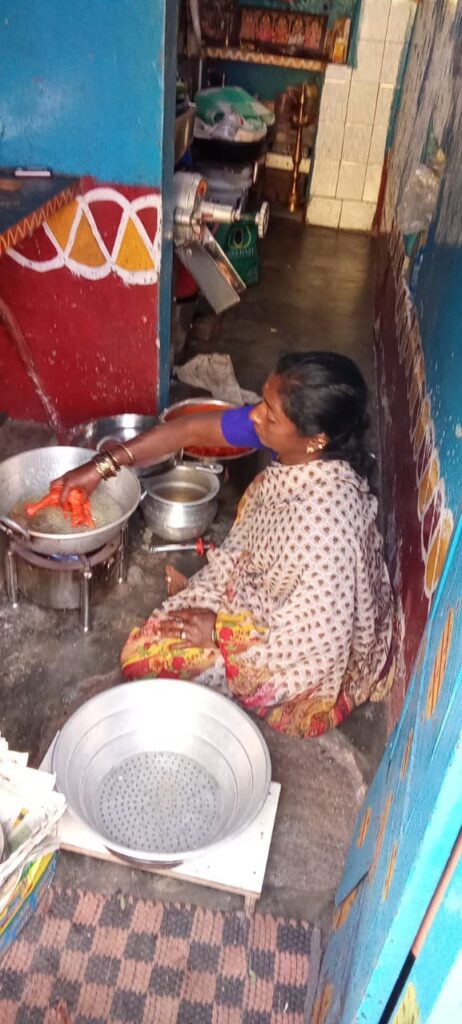
Sathya, a Kirana Shop owner, at her home |
PC: Udhyam Vyapaar Team
Designing for Continuity
When the goal is sustained growth, then support cannot be momentary. It has to extend beyond the duration of a program. This requires a shift in how we design interventions:
- From one-time engagement to ongoing usability
- From knowledge transfer to habit formation
- From external guidance to embedded support systems
Assets play a central role in this.
They act as a bridge between intervention and independence, ensuring that even after the program ends, the entrepreneur is not left without support.
This is evident in entrepreneurs like Vijayalakshmi, a street food vendor. For her, the biggest constraint was not demand for her food, but the inability to keep food warm while selling. Because of this, she could only carry small quantities, limiting her income. In order to solve this, the Udhyam team provided her with a large hotbox, and supported her to purchase a microwave and induction stove. With this access, she was able to maintain food quality for longer and increase the volume she sold without changing what she made.
In this way, a single asset, the hot box, removed a structural constraint, enabling her business to grow while staying true to its core.
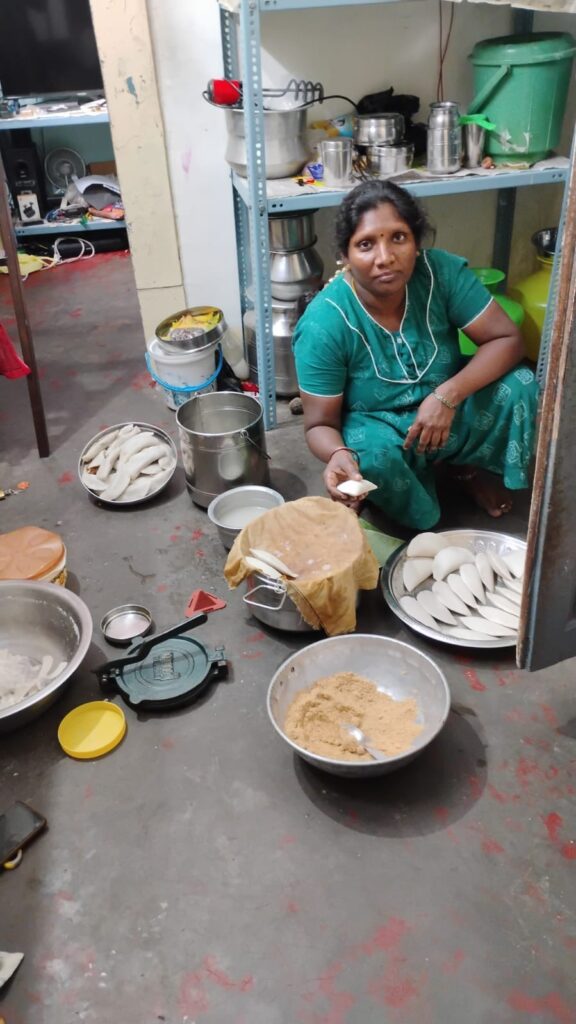
Vijayalakshmi, at her home making modaks, known locally in Karnataka as “kolukatte” |
PC: Udhyam Vyapaar Team
Rethinking Support
This is not to say that training has no role.
Knowledge and guidance are important and they are definitely needed. But on their own, it is often insufficient.
At Udhyam Vyapaar what enables real, sustained change is a combination of:
- Understanding
- Practical tools
- Continued usability
Support, in this sense, is not something that is delivered and completed.
It is something that is designed to stay.
This project supports women nano-entrepreneurs who are a part of the informal waste picker community, as part of the Saamuhika Shakti initiative – a collective effort to create pathways toward dignity, stability, and hope.