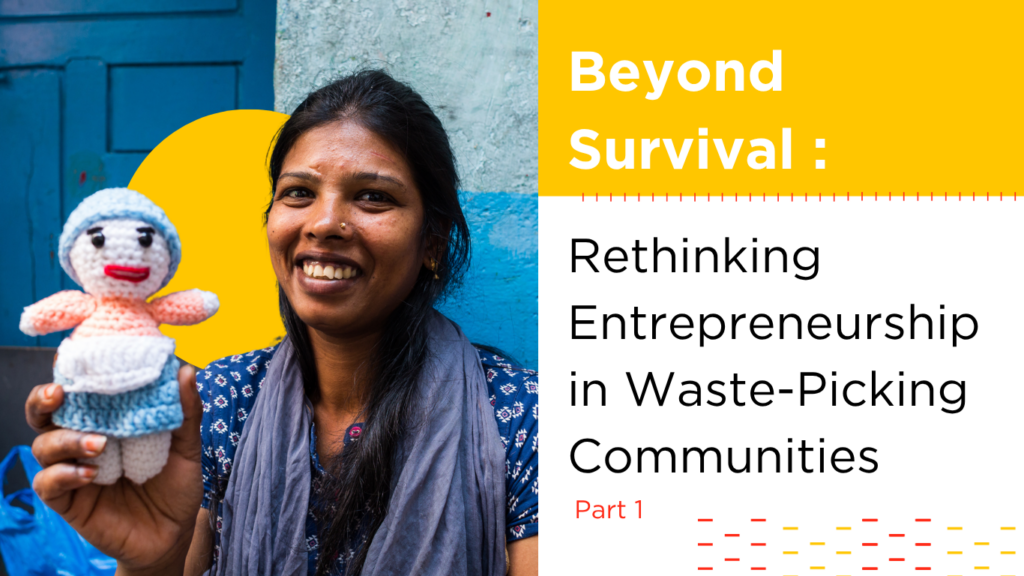
Working on One : Lessons from working for Collective Impact through Saamuhika Shakti

Complex social challenges rarely exist in isolation. They are shaped by overlapping systems, economic, social, cultural, and institutional, and no single organisation can address them all alone. This understanding lies at the heart of collective impact, a model that brings together multiple organisations around a shared vision, aligned strategies, and coordinated action.

Saamuhika Shakti was built on this belief.

Saamuhika Shakti, initiated and funded by the H&M Foundation, is a structured collective impact initiative in Bengaluru that brings together organisations with deep, complementary expertise to address the interconnected challenges faced by informal waste pickers and their families. Working across livelihoods, entrepreneurship, education, health, social protection, and community systems, the collaboration focuses on bridging systemic gaps that perpetuate vulnerability. By combining economic interventions with efforts to address social, institutional, and gender-based barriers,  including access to entitlements, safety, dignity, and changing societal perceptions, Saamuhika Shakti takes a holistic approach to enabling waste-picking communities, to build more secure, dignified, and sustainable futures.
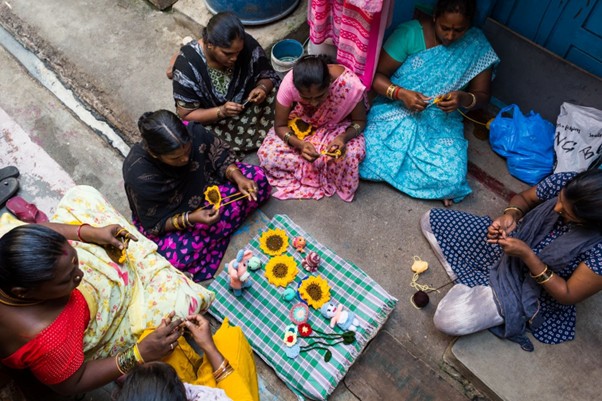
Why Collective Impact Matters in Informal Livelihoods

In waste-picking communities, livelihood decisions are rarely linear. Work choices are shaped by a constant balancing of informal enterprise, wage-based work, caregiving responsibilities, debt cycles, migration, and seasonal pressures. Entrepreneurship, in this context, is often intermittent and adaptive rather than continuous.
Early in the program, several women who had been identified as nano-entrepreneurs paused or discontinued their businesses to take up housekeeping or waste-picking work that offered immediate daily wages. From a single-organisation lens, this could have been seen as “drop-out.”

Within the collective, however, partners have the opportunity to align on a shared understanding: income stability mattered as much as business continuity. This reframing will allow the program to stay engaged with these women, instead of exiting them prematurely.

Collective impact created space to recognise real livelihoods, not idealised ones.
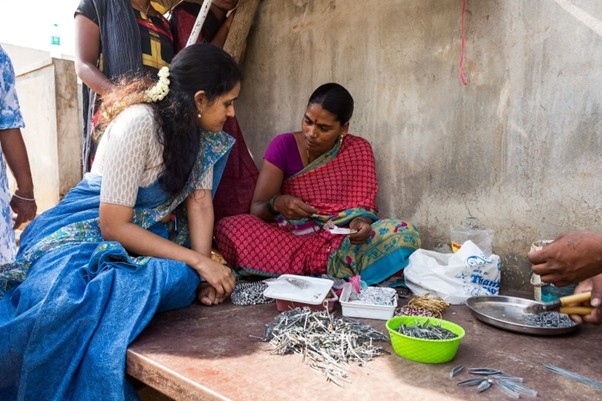
The Value Created by Udhyam Vyapaar in Saamuhika Shakti

By functioning in a collective rather than as parallel programs, Udhyam Vyapaar in Saamuhika Shakti was able to:

  • Design tailored entrepreneurship support
  • Enable over 100 nano-entrepreneurs to achieve income uplift despite non-linear pathways
  • Strengthen dignity, agency, and confidence alongside economic outcomes

For the community, this meant engaging with a coherent ecosystem of support, rather than navigating fragmented interventions from multiple organisations.

Reflections for the Road Ahead

Collective impact is rarely quick or linear. It is most often applied in contexts of deep complexity, where change unfolds over time and requires sustained collaboration, trust-building, and alignment across organisations. It requires time, humility, negotiation, and continuous alignment. It asks organisations to slow down, listen deeply, and give up sole ownership of success.

No single organisation can respond to the full complexity of life in waste-picking communities. Different families face different constraints, related to income, health, education, safety, or social identity and meaningful change requires these realities to be addressed together, not in isolation.

For Udhyam Vyapaar, the future we are working toward in Saamuhika Shakti is one where multiple organisations engage with different parts of the same community, and often the same family, in a coordinated way. While one organisation may work closely with women on livelihoods or entrepreneurship like we do, another may support access to education, health, social security, or safety. Over time, this collective approach reduces fragmentation, allowing families to experience support as interconnected rather than piecemeal.

By keeping women at the centre, we recognise their central role within households as earners, caregivers, and decision-makers. When women gain more stable and dignified livelihood pathways, the effects extend beyond individual income to influence children’s schooling, household resilience, and the ability to plan for the future. 

Being a part of Saamuhika Shakti’s experience reinforces a powerful lesson:
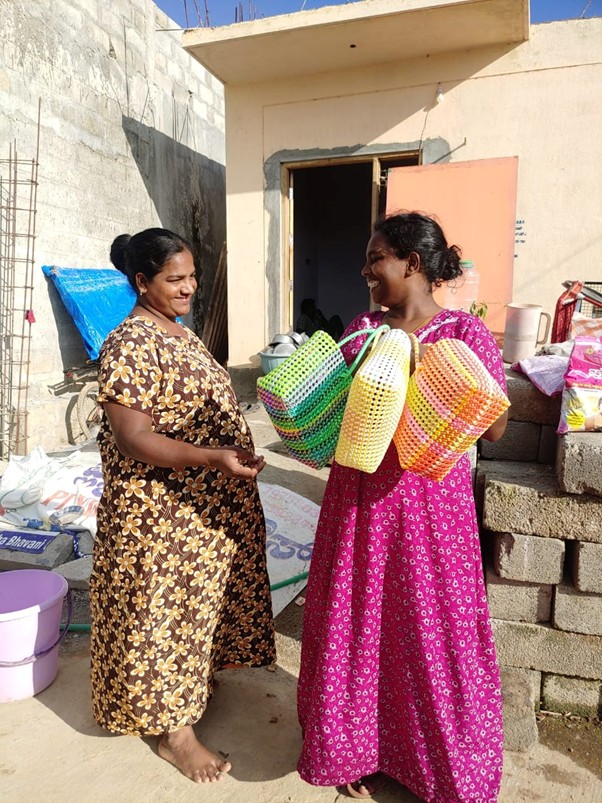
When organisations align around people and not programs, solutions become more grounded, more humane, and more sustainable.

As the collective continues to evolve, its strength lies not just in shared outcomes, but in the shared intent to learn continuously, adapt, and build systems that reflect the lived realities of the communities they serve.
Recent Blogs

Jeeva’s Journey: Restarting a Dream, One Step at a Time

When Jeeva first approached Udhyam Vyapaar, she was already someone with tremendous potential.

Measuring Success: Jayshri’s Journey From Guesswork To Growth

In the bustling lanes of Subhash nagar, Shirpur, Jayshri Ravindra Pardhi has been

How Rural Entrepreneurs Are Building a New India

India is a country of villages. The majority of the Indian population is

Shankar Maruwada is the Co-Founder and CEO of EkStep Foundation, a philanthropic mission he co-founded in 2015 along with Nandan Nilekani and Rohini Nilekani, to improve basic education for 200 million children in India. The Foundation has co-created an open-source free to use digital infrastructure called Sunbird (www.sunbird.org) which works towards achieving this purpose. DIKSHA, the national school education platform, is one of multiple national initiatives that leverage Sunbird to provide access to digital content for learners and for capacity building of teachers. He has more than 25 years of experience across corporate, entrepreneurial, nonprofit and government sectors. This allows him to bring the best of thinking from different lenses, which he has used in shaping EkStep’s mission and its strategic choices of achieving population scale impact for learning, using technology. Shankar is deeply passionate about leveraging technology for large scale transformation in society. He was part of the startup team at Aadhaar; in fact, he was responsible for naming it. He also set up one of India’s first data analytics companies – Marketics. This cross-sectorial experience and interdisciplinary approach has been a driving force in pursuing scale solutions, innovations and collaborations for EkStep’s education mission. He also mentors startups, social entrepreneurs and not-for-profits. Shankar is a member of the National Steering Committee tasked with developing the National Curriculum Frameworks based on the National Education Policy, 2020. He also been on multiple Government committees and task forces, including DIKSHA, NDEAR (National Digital Education Architecture), iGOT (Integrated Government Online Training). His alma mater IIT Kharagpur’s motto of ‘yogah karmasu kaushalam’ (Yoga is excellence at work) and its message of ‘Dedicated to the service of the nation’ is also his chosen path in life. He is also an alumnus of Indian Institute of Management, Ahmedabad.

R. Natarajan, fondly called Nats, co-founded Foundation partners in July 2018 advising companies on scaling, governance and profitability. Prior to this he was Chief Operating officer at UC RNT Fund, managing USD 400 Mn and Managing Director at Helion ventures, a VC firm with Asset under management of over USD 1 Bn for 10 years, and in various leadership roles in Tavant Technologies Inc., US, and Wipro for 13 years. He is a qualified finance professional and a certified black belt in Six sigma by Motorola University. He is on the Board of studies at Christ University and in the Advisory board of Shasun College for Women in Chennai, Bethany High school Bangalore and Byramjee Jeejeebhoy School and College at Mumbai. He also serves on the Board of PHFI (Public Health Foundation India) and also a trustee of Youth For Seva, a large NGO focusing on self-reliant communities powered by selfless individuals for the last 13 years, currently whose volunteers cross 1 lac and beneficiaries cross 10 Cr across 14 states.

“Every human being deserves a dignified life out of poverty, and it’s well in our collective means to achieve that goal.”After 17 years of starting, scaling and turning around various businesses in some of the largest and most respected organisations globally, Atul started The/Nudge Foundation to do poverty alleviation work. Atul is now serving both The/Nudge and Givelndia as their CEO. Over his 5-year stint at InMobi as its Chief Business Officer, Atul helped scale the organisation to a global leader in mobile advertising, with operations in 20+ countries. Atul also served on the Board of Mobile Marketing Association. Prior to InMobi, Atul was the Head of Mobile Business for Japan & Asia-Pacific at Google. Atul has also done various general management, business development and sales roles across technology companies, including Adobe, Samsung and Infosys. Atul also served EndPoverty, a non-profit, as Chairperson for two years, working on various aspects of poverty, including water, sanitation, education, skill development, sustainability and women empowerment, and continues to serve as their Board Member. Atul has been named in the #40underForty list by The Economic Times in 2017. Atul holds a Master in Business Administration (MBA) from the Indian School of Business and a B-Tech from the National Institute of Technology.

Binny Bansal is an Indian internet entrepreneur, who co-founded Flipkart, the leading e-commerce marketplace in the country. At Flipkart, he donned several hats including Chief Operating Officer, Chief Executive Officer, Group CEO, and Chairman. Post his graduation in Computer Science & Engineering from IIT Delhi, Binny worked at various companies, including a stint at Amazon India. In October 2007, along with his Amazon colleague, he co-founded Flipkart, an online book store based out of Bengaluru. In 2018, Binny steered Flipkart to close the largest global M&A deal in e-commerce, when Walmart acquired a majority stake in the company at an enterprise valuation of $22 billion. Binny is currently an entrepreneur-investor and mentor in the startup ecosystem. He has invested in several early stage startups, including Stellaps, Ather, Increff, Inshorts, Tracxn and Goodera. Growth stage startups include Acko, Cure.fit, Rupeek and GreyOrange, to name a few. Binny also co-founded xtolOx Technologies, offering technology tools, learning platforms and consultancy services to enable growth stage startups scale 10x. In December 2019, Binny relocated to Singapore with his family. Binny was ranked 26th among India’s 50 Most Powerful People in 2017 by India Today, and was awarded the 2016 “Asian of the Year” award by Straits Times of Singapore.

Narayan Ramachandran is an accomplished investment professional and social entrepreneur with over 20 years of experience in global finance and developmental economics. He previously served as the Country Head of Morgan Stanley India and was the lead portfolio manager of its Global Emerging Markets and Global Asset Allocation teams, managing assets worth over $25 billion. Narayan is currently the Chairman and CEO of KludeIn I Acquisition Corporation and co-Chairman of Unitus Capital, India’s largest social enterprise bank. He is also actively involved in social impact through InKlude Labs, which scales interventions in education and public health, and serves on several boards including Vivriti Asset Management and Caspian Debt. Narayan holds a B.Tech. in chemical engineering from IIT Bombay and an MBA from the University of Michigan. He is known for connecting ideas, people, and capital to drive impactful change in areas such as social enterprise, environment, and global finance.

linkedin.com/in/narayan-ramachandran-a6b2941b8

Abhishek Poddar is a prominent Indian industrialist, art collector, and patron of the arts. He is the Founder-Trustee of the Museum of Art & Photography (MAP) in Bengaluru, to which he has donated a substantial portion of his family’s art collection and the initial leadership gift. As Managing Director of Matheson Bosanquet, an 80-year-old company specializing in tea production, trading, and export, and Director at Sua Explosives & Accessories, a leading manufacturer of mining explosives in India, Poddar balances business leadership with cultural philanthropy. He also serves on advisory committees of several esteemed organizations including the India-Europe Foundation for New Dialogues and the Lincoln Centre Global Advisory Council. Recognized among Asia’s 2018 Heroes of Philanthropy by Forbes, he is deeply committed to promoting India’s rich artistic heritage.
He was born in Kolkata, attended Lamartiniere for Boys and The Doon School, and graduated from St. Xavier’s College, Kolkata.

linkedin.com/in/abhishek-poddar-map

Ireena Vittal is a leading adviser on sustainable growth, digital transformation, and organizational scale-up. She serves on the boards of Asian Paints, Godrej Consumer, Diageo PLC, and Compass PLC, and advises nonprofits in education, legal reform, rural livelihoods, water, and urbanization. A former McKinsey partner for 16 years, she worked with global companies and co-authored influential reports on economic growth, agriculture, and urbanization. She holds a degree in Electronics from Osmania University and a PGDBM from IIM Calcutta.

Please drop your name and email id to download Brand Logos