From the Real-World AI Casebook to the South-South Dialogue and the AI for Global Development Demo Day
The India AI Impact Summit 2026 in New Delhi brought together governments, researchers, funders, and technology leaders to examine one central question: how can AI move from promise to real public impact?
For Udhyam Learning Foundation, this was not a hypothetical conversation.
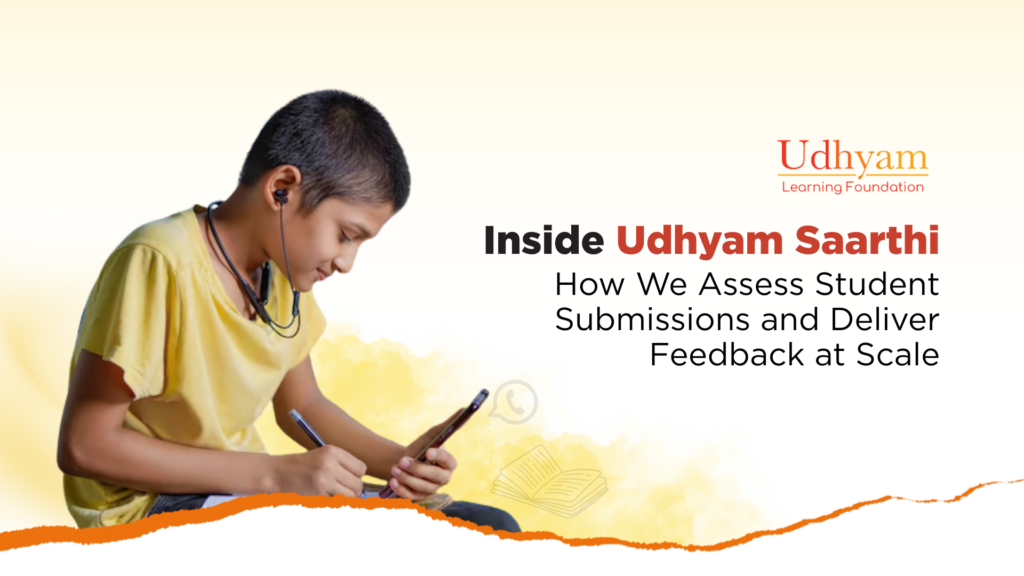
Udhyam arrived at the Summit with Udhyam Saathi, our AI mentor already active in classrooms across India. A system supporting over 350,000 students, working with 25,000 teachers, processing more than 200,000 student submissions in just four months, and operating in five languages.
What unfolded over the week placed that work in three distinct but connected conversations.
Real-World AI Casebook: Recognition for What Is Already Working
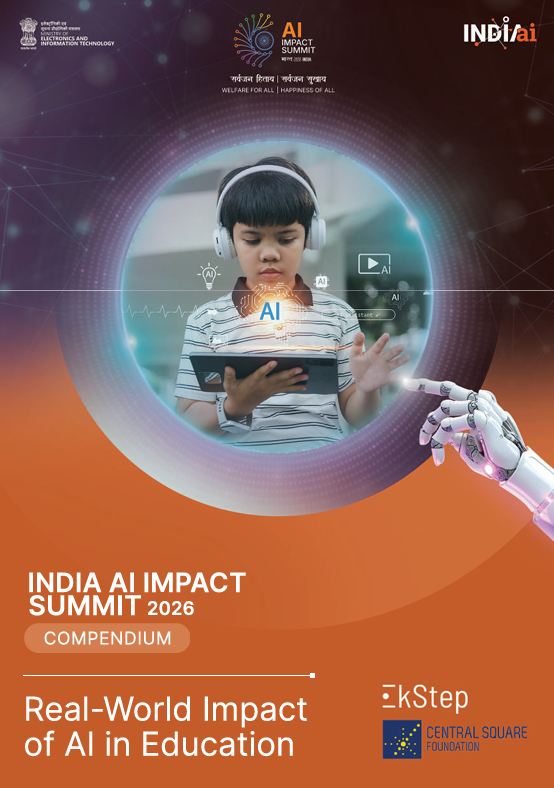
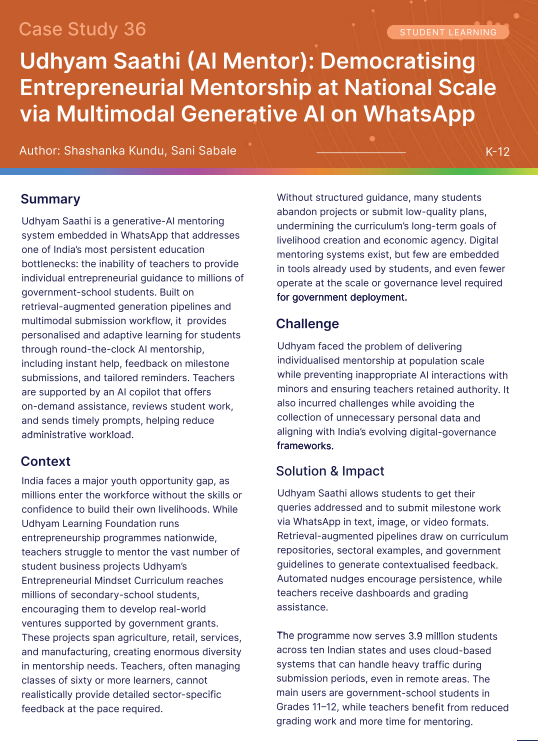
One of the defining moments of the Summit was the launch of the Casebook on Real-World Impact of AI in Education. Out of more than 270 global applications, 36 AI solutions were selected for inclusion. Udhyam Saathi was one of them.
This casebook focused on solutions that are not theoretical models or early pilots. It documented AI tools that are already functioning inside real systems.
Udhyam Saathi was featured because of how it operates at scale within public education. Students submit their work through WhatsApp in text, image, or video formats. Saathi responds with structured guidance designed to help them think deeper and refine their ideas. Teachers access a web interface that helps them see patterns and progress without manually reviewing every submission.
South X South Dialogue: AI Designed for the Realities of the Global South
Udhyam was invited to attend the Summit’s South X South dialogue, an event focused on cooperation across the Global South in deploying AI for public good.
The broader Summit conversations emphasised inclusive digital public infrastructure and scalable systems. Among prominent voices at the Summit was Nandan Nilekani, Co-Founder and Chairman of Infosys, and Shankar Maruwada, Co-Founder and CEO of EkStep Foundation, both of whom have long advocated for population-scale digital infrastructure.
The themes discussed in that forum closely reflect the design decisions behind Udhyam Saathi.
Saathi runs on WhatsApp because that is where learners already are. It supports multiple languages because classrooms are multilingual. It integrates into existing school systems rather than requiring a parallel platform.
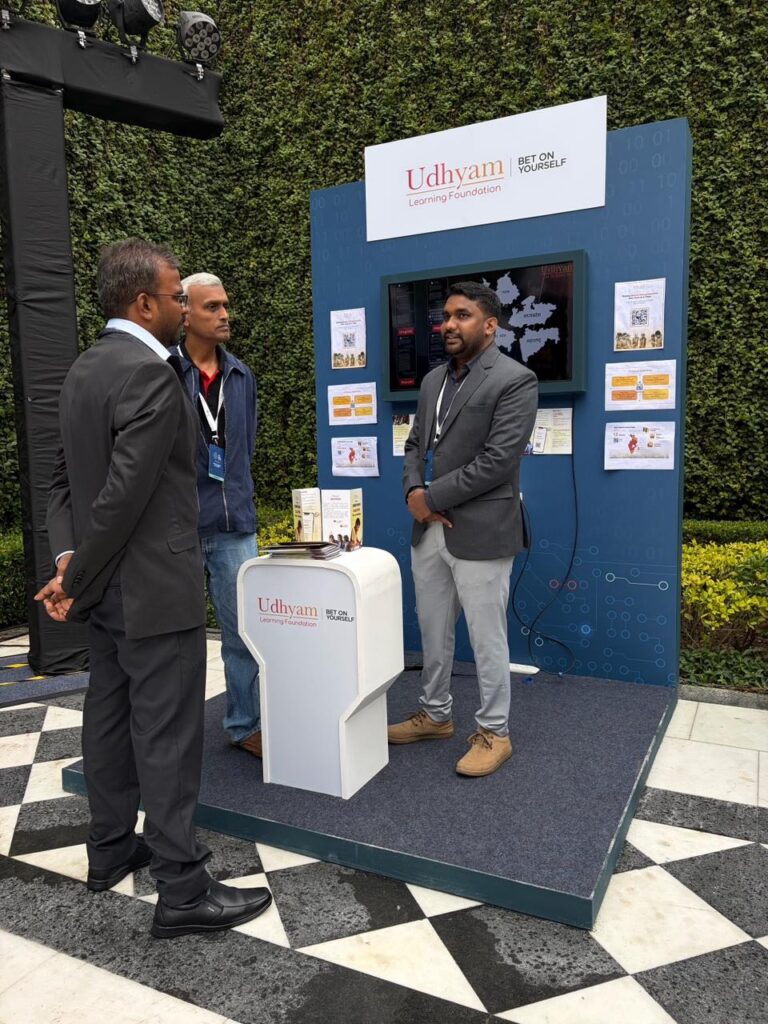
In addition to participating in the dialogue, Udhyam also showcased Udhyam Saathi at a booth set up at The Oberoi hotel, where the South X South event was hosted. The booth created space for deeper conversations with policymakers, researchers, and ecosystem partners about how the product works in real classrooms and how it can scale responsibly within public systems.
Udhyam’s participation aligned directly with the Summit’s focus on inclusive AI for public systems.
AI for Global Development Accelerator: Demonstrating Saathi Live
A key moment at the Summit was the Demo Day of the AI for Global Development Accelerator, led by The Agency Fund in collaboration with OpenAI and the Center for Global Development.
Udhyam was selected as one of eight organisations globally in the 2025 cohort, receiving 500,000 dollars in funding along with OpenAI credits and technical guidance to strengthen Udhyam Saathi’s capabilities and evaluation framework.
On February 19, Mekin Maheshwari, Founder and CEO of Udhyam Learning Foundation, presented Udhyam’s journey and demonstrated Udhyam Saathi, the AI Mentor app.
He walked the audience through how students and teachers are guided through the program journey with an AI Mentor addressing their queries, assessing milestone submissions in text, image, and video formats, and responding with structured guidance and personalised, holistic feedback. The focus was clear: how do we provide consistent, meaningful support to students and teachers both inside and outside the classroom without adding pressure on teachers?
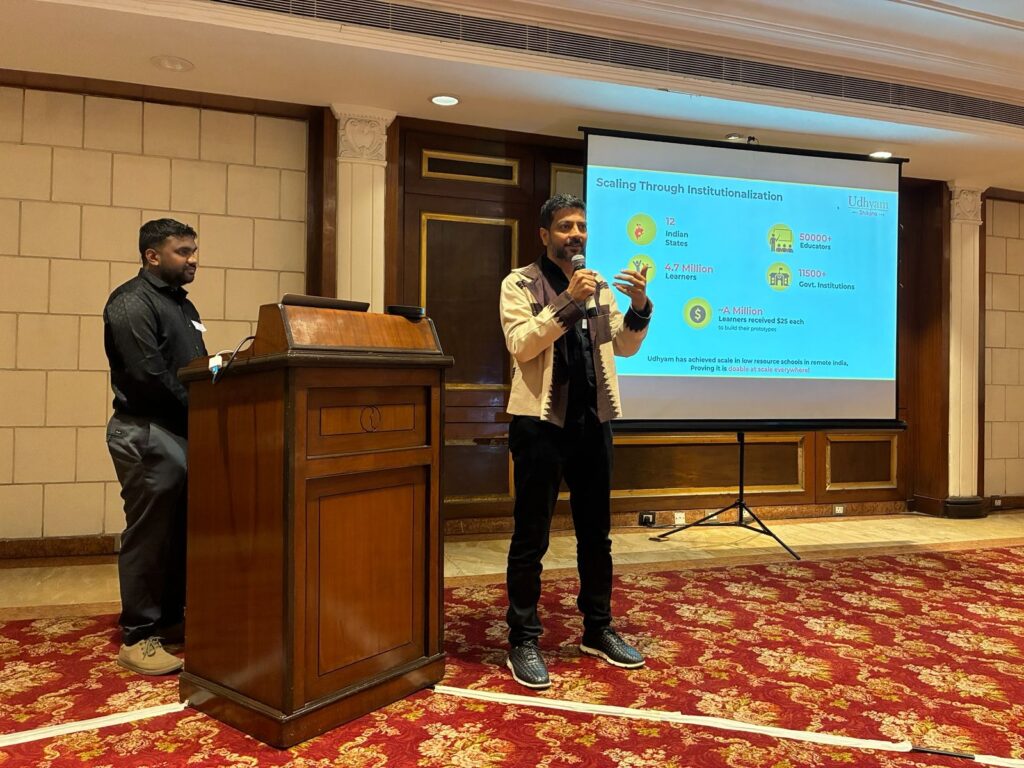
What followed was an engaging exchange with delegates from OpenAI, Centre for Global Development, representatives from J-PAL, policymakers, researchers, and other international organisations. The discussion moved beyond features and into outcomes, measurement, and long-term system integration.
Udhyam Saathi was not positioned as a standalone tool, but as a problem-solving layer within education systems. A way to extend mentorship at scale while staying grounded in real classroom needs.
The response in the room reflected genuine interest and thoughtful appreciation for both the positioning and the functionality of the solution.
A Week That Reflected Where Udhyam Stands Today
Across the Casebook launch, the South-South dialogue, and the AI for Global Development Demo Day, a clear pattern emerged.
Udhyam is no longer describing what AI in education could become. It is demonstrating what it already is.
A multilingual AI mentor supporting hundreds of thousands of learners.
A system embedded in real classrooms.
A product tested in live environments and examined by global partners.
The Summit offered visibility, conversation, and scrutiny. What it reinforced was something more enduring.
Udhyam Saathi is part of the everyday work of helping students think, build, and move forward.
And that work continues well beyond any summit stage.